
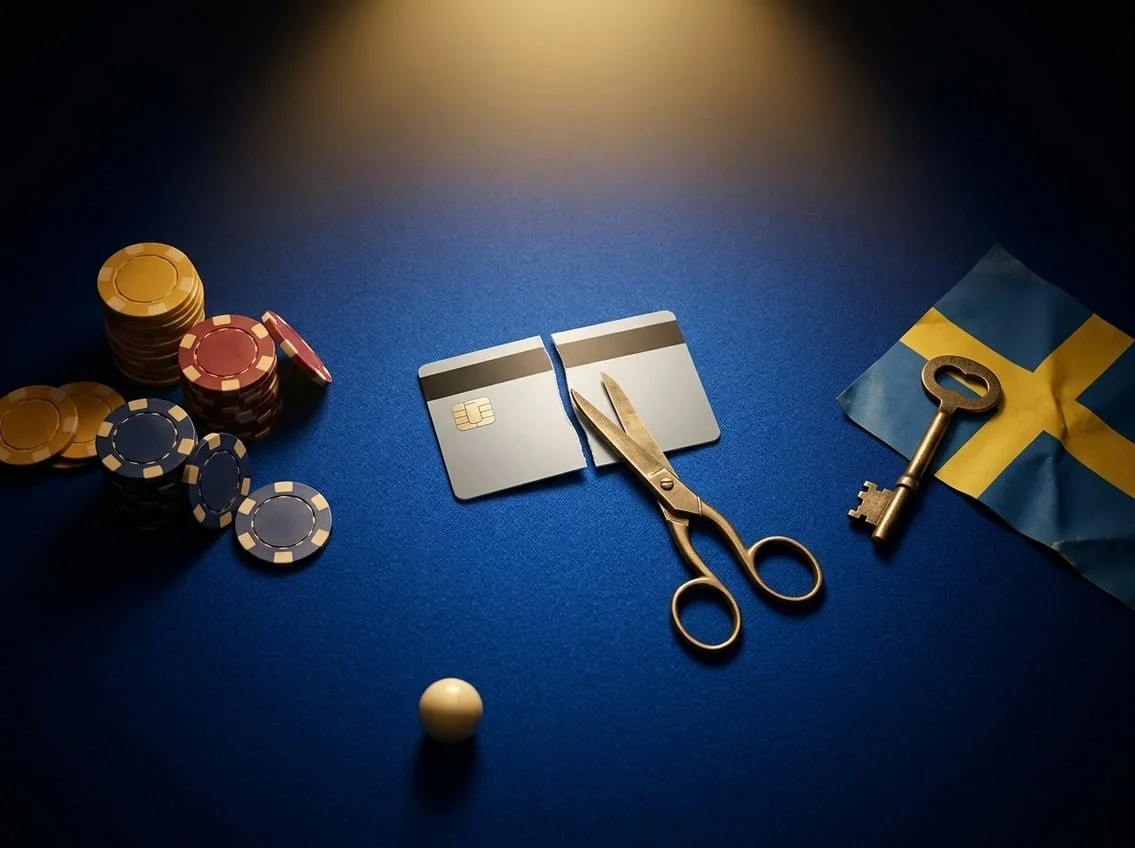

Two policy changes landed on Swedish gamblers in 2026, close enough together to be treated as one event and different enough that treating them that way misses what is actually going on. The first was the closure of Casino Cosmopol Stockholm on 1 January, formally ending state-operated land-based casino gaming in Sweden. The second was the credit-card gambling ban that took effect on 1 April, prohibiting all Spelinspektionen-licensed operators from accepting credit as a source of gambling funds.
Read as isolated policy items, each has a straightforward rationale. Casino Cosmopol had been losing money and player traffic for the better part of a decade, and Svenska Spel had been open about the direction of travel for at least three years. The credit-card ban was a long-signalled harm-reduction measure that broadly follows what the UK did in 2020 and what several EU countries were phasing in through the mid-2020s. Neither change was a surprise.
Read as combined market pressure, the picture is different. The Cosmopol closure removes the only fully-regulated land-based casino product available in Sweden. The credit-card ban makes the fully-regulated online product materially less accessible to players who were funding play from credit. Together, the two changes narrow the licensed offering while doing nothing directly about the offshore alternative, which is not subject to either restriction. Nine months into the post-changes market, this article walks through what has actually happened, based on our own testing of the Swedish market and public data from Spelinspektionen and Statistiska centralbyrån.
What Casino Cosmopol was, and what its closure means
Casino Cosmopol was Svenska Spel's chain of state-owned land-based casinos, opened between 2001 and 2003 in Stockholm, Gothenburg, Malmö, and Sundsvall. The Sundsvall venue closed in 2020. Malmö followed in 2022. Gothenburg closed in mid-2024. The Stockholm venue, the largest and best-performing of the four, held on until the 1 January 2026 closure date announced by Svenska Spel in September 2025.
At its peak in the late 2000s, Casino Cosmopol served over a million guest visits per year across all four venues. By 2024, the Stockholm venue alone accounted for less than a third of that traffic. Structural factors were the main driver: an ageing customer base, competition from a rapidly growing licensed online market after Sweden's 2019 gambling reform, and the practical reality that a night out at a physical casino was becoming a less common leisure choice for the demographic that historically drove land-based casino revenue.
The closure is not the disappearance of licensed casino gaming from Sweden. Online casino operators licensed by Spelinspektionen (Betsson, LeoVegas, Videoslots and dozens of others) continue to serve the Swedish market and are not affected by the Cosmopol closure. What is gone is the option to play regulated casino games in a physical Swedish venue with Swedish currency. For a player who preferred that format, there is no domestic replacement. The nearest equivalents are cross-border land-based casinos, primarily in Denmark, Estonia, and Finland.
The direct player-facing consequence is small. The indirect consequence, which is that the Swedish state has now formally exited the land-based casino operating role, is larger for what it signals about the government's view of the physical casino product as a public-policy matter. That signal is aligned with the broader regulatory posture Sweden has taken since the 2019 reform: more restrictive on advertising, more focused on harm reduction, less accommodating of aggressive commercial promotion.
What the credit-card ban actually prohibits
The prohibition that took effect on 1 April 2026 covers all Spelinspektionen-licensed operators offering online gambling to Swedish residents. It prohibits the acceptance of credit-card payments and payment instruments that draw on credit. The scope is deliberately broader than "credit cards" in the everyday sense. It captures buy-now-pay-later arrangements used as gambling funding, credit-linked digital wallets when the wallet is drawing from a credit line, and any payment product whose funding source is not the player's own available funds.
Debit cards are not affected. Bank transfers via Trustly and its competitors are not affected. Swish is not affected. Prepaid cards funded with the player's own money are not affected. What is affected is any funding path where the money being played was borrowed at the point of gambling.
The enforcement mechanism is straightforward. Operators are required to identify the funding source of a payment instrument and refuse it if the source is credit. Payment processors serving licensed operators have been building the technical checks through late 2025. The most common approach is to use the standard BIN (bank identification number) database to flag credit-card BINs and reject them at the operator cashier, and to require operator-side attestation on non-card rails that the funds are not credit-sourced.
There is a compliance grey zone. A debit card drawing on a bank account whose overdraft facility is active is technically debit at the point of transaction but credit in economic substance. Spelinspektionen's guidance treats overdraft-funded debit-card transactions as debit for compliance purposes. That is a pragmatic reading given the technical difficulty of the alternative, and it means the ban is a bit less complete than the headline suggests. In practice, the ban still cuts off the majority of credit-funded gambling activity at licensed operators.
What Spelinspektionen data shows nine months in
Spelinspektionen publishes quarterly market data. The Q2 and Q3 2026 releases are the first two full quarters after the credit-card ban took effect, and the numbers tell a consistent story with two components.
Deposit volume at licensed online operators dropped in Q2 2026 by around six percent compared to Q1 2026 on a like-for-like basis, having grown by two to three percent quarter-over-quarter through 2025. The decline was concentrated in card-payment deposit volume specifically, which fell by around eighteen percent, while bank-transfer and Swish deposit volume held steady or grew slightly. The net effect: card deposits, which were around thirty-eight percent of licensed-market deposit volume in Q1 2026, fell to around twenty-nine percent by Q3 2026.
Total licensed-market GGR (gross gaming revenue) declined by roughly four percent through the two quarters combined. That is a smaller decline than the deposit-volume decline suggests, which is consistent with the harm-reduction rationale: the players most affected were those depositing on credit, and credit-funded gambling correlates strongly with problem-gambling behaviour and high-loss sessions.
The number Spelinspektionen does not publish, and cannot easily estimate, is what happened to the deposit volume that no longer appears in the licensed-market data. Some of it stopped being gambling activity entirely, which is the outcome the harm-reduction policy was designed to produce. Some of it moved to offshore operators (casinos utan svensk licens) which are not subject to either the credit-card ban or Spelinspektionen's reporting. Our own traffic data on the Casino Utan Spelpaus page shows sustained growth in query volume through Q2 and Q3 2026, meaningfully above the year-earlier baseline. The direction of movement is clear even if the magnitude is not directly measurable.
What players actually see at the cashier
At a Spelinspektionen-licensed operator today, the cashier looks materially different from a year ago. The card-payment button either does not appear or appears with a message explaining that Visa and Mastercard credit products are no longer accepted. Debit is still available at operators that offer it, but the visual prominence of the card option has shifted downward. Trustly, Swish, and other pay-by-bank options are now the primary payment methods on the cashier's first screen.
Operators have responded to the credit-card removal by making bank-transfer options more prominent and by reducing minimum deposit thresholds on those rails. Swish, in particular, has become the default primary rail for many licensed operators, benefiting from its integration into the majority of Swedish personal banking apps and its instant-settlement performance.
Ongoing promotions have been quiet. There is no evidence in the operators we have tested that welcome bonuses, wagering requirements, or VIP structures were materially adjusted in response to the credit-card ban. The commercial impact was mostly a volume story rather than a margin story, and margin was not what operators needed to defend.
The offshore-market response
Casinos operating under Malta (MGA), Curaçao, and other non-Swedish licences continue to accept Swedish players and continue to accept credit-card payments where the operator's own risk appetite permits. Neither the Cosmopol closure nor the credit-card ban applies to these operators. From a Swedish player's perspective, credit-card gambling remains available; it just requires playing at an offshore operator rather than a Spelinspektionen-licensed one.
That trade-off carries the usual set of considerations. Offshore operators are not connected to Spelpaus, Sweden's national self-exclusion register. For a player who has voluntarily registered with Spelpaus, playing offshore defeats the point of that registration, and it is one of the population-scale harm-reduction concerns raised by critics of the credit-card ban policy. Offshore operators are not subject to Spelinspektionen's advertising, bonus, or player-protection rules, so the individual player experience varies more widely from operator to operator than it does in the licensed market.
On the positive side of the trade-off, offshore operators are subject to their own licensing framework's requirements. An MGA-licensed casino is a materially different proposition from a low-tier offshore-only operator, and the MGA framework carries real player protections even though it is not Sweden's. A Curaçao-licensed casino operating under the post-LOK framework carries the protections we detailed in our Curaçao LOK retrospective, which are meaningfully stronger than they were two years ago.
The direction of movement in the market data is not surprising. The mechanics of it are straightforward: a subset of players who preferred credit-card payment either stopped playing, migrated to non-card payment methods at licensed operators, or continued playing on credit at offshore operators. The proportion in each bucket determines whether the credit-card ban was a successful harm-reduction measure or a channelling failure. It will take another twelve to eighteen months of data before that verdict is possible to reach cleanly.
What the changes mean for our Swedish shortlist
Our Swedish-market coverage on the Sweden hub covers both Spelinspektionen-licensed operators (the licensed market) and offshore operators serving Swedish players (the utländska casinon category). Both parts of the shortlist reflect the market as it now stands, not as it was before April 2026.
For readers who prefer the licensed market, the Spelinspektionen-licensed operators on our shortlist have transitioned cleanly to the post-ban cashier. Deposit options are now organised around Trustly, Swish, and debit; welcome offers remain broadly in line with pre-ban rates; withdrawal timings have not degraded. If you are a player whose gambling budget comes from own funds (not credit), the licensed-market experience is materially unchanged, and the harm-reduction environment has strengthened.
For readers looking at the utländska casinon route, the practical trade-offs described above apply. Our Casino Utan Spelpaus page covers what is available in the offshore market and where the trade-offs sit. The critical honest disclosure: if you have registered with Spelpaus for self-exclusion, an offshore operator is not the appropriate answer to any question, no matter how good its bonus terms are. The correct response is to talk to someone. Stödlinjen, Sweden's national gambling-harm helpline, is available around the clock.
What to watch through 2027
Several second-order effects will play out over the next twelve months and are worth tracking.
- Q4 2026 and Q1 2027 Spelinspektionen data. The Q4 release, typically published in February, will be the first full-year post-ban read. If the offshore-migration proportion is high, the political case for further restrictions weakens; if the channelling rate to licensed alternatives is high, the case for a similar approach on other funding routes (buy-now-pay-later, for instance) strengthens.
- Spelpaus registrations. The number of active Spelpaus registrations rose steadily through 2025 and is expected to continue rising into 2026 and 2027. This is generally read as a positive indicator: it means the self-exclusion mechanism is being used. It also raises the ceiling on the population of Swedish players for whom offshore casinos are an obvious workaround.
- The Casino Cosmopol staff transition. Svenska Spel committed to redeployment of Cosmopol Stockholm staff into its digital operations and other business units. Whether that redeployment happens cleanly matters for the political optics of any future gambling policy change.
- EU-level coordination. Sweden's credit-card ban follows the UK's and precedes similar measures being considered in several other EU markets. Coordination on offshore-market enforcement is politically difficult, but there is growing interest in the concept at EU level.
Frequently asked questions
Can I still gamble in Sweden with a credit card?
Not at a Spelinspektionen-licensed operator. Since 1 April 2026 all licensed operators must decline credit-card payments and any other credit-sourced funding. You can still gamble with a credit card at an unlicensed offshore operator, but that is a different regulatory environment with different trade-offs, and it is not the appropriate answer if you have registered with Spelpaus for self-exclusion.
Where can I play land-based casino games in Sweden now?
Nowhere, in the state-operated sense. Casino Cosmopol Stockholm was the last venue and closed on 1 January 2026. A small number of private clubs and event locations offer occasional casino nights under limited licence conditions, but there is no continuous land-based casino operation in Sweden. The nearest large land-based casinos are Casino Copenhagen and Casino Marienlyst in Denmark, and Olympic Park Casino in Tallinn, Estonia.
Does the credit-card ban affect debit cards or Swish?
No. Debit cards, Swish, Trustly, and other pay-by-bank options are unaffected by the ban. They draw from the player's own available funds, which is what the policy is designed to preserve as the funding basis for licensed gambling. Overdraft-funded debit transactions are treated as debit for compliance purposes even though they are credit in economic substance; this is a documented pragmatic reading.
Are the offshore casinos safe to play at?
The honest answer is: it depends heavily on the operator. An MGA-licensed casino carries real player protections. A Curaçao-licensed casino under the post-LOK framework carries meaningful protections, though not equivalent to Spelinspektionen. A low-tier offshore-only operator carries no meaningful protection beyond the operator's own commercial reputation. If you are considering an offshore route, the licence is the first thing to verify, and the operator's independent review record is the second. Our MGA casinos and Casino Utan Spelpaus pages cover both categories with the trade-offs identified.
What happens if I have registered with Spelpaus and want to play again?
The correct answer is to wait out your registration period and, ideally, to talk to Stödlinjen (020 819 100, or via the website) before you resume. Playing offshore during an active Spelpaus registration defeats the purpose of the registration and is a pattern strongly associated with gambling-harm relapse. This is one of the situations where the policy tradeoffs of the offshore market alignment work against players who most need the protection.
Will more restrictions follow?
Probably some, though nothing specific is currently proposed. The buy-now-pay-later category (Klarna and similar) is the obvious next candidate for scrutiny given the substitution question raised by the credit-card ban. The advertising framework has already tightened progressively since 2019 and there is political appetite for further tightening. The 2027 Spelinspektionen data will inform the government's next moves.
Sources and further reading
- Spelinspektionen quarterly market data releases, Q1 through Q3 2026.
- Svenska Spel Casino Cosmopol closure announcements and financial disclosures.
- The 2025 amendments to the Swedish Gambling Act (Spellagen) implementing the credit-card ban.
- Stödlinjen (Sweden's national gambling-harm helpline) 2025 and 2026 activity reports.
- Our own monthly testing of the Spelinspektionen-licensed and offshore operators on our Swedish shortlist, January through November 2026.
This article was published on 3 December 2026 and reflects the state of the Swedish market as of that date. Q4 Spelinspektionen data will be published in February 2027; we will update this article with the first full-year post-ban read when it lands. If you spot something we have missed in the Swedish market, tell us on the contact page. If you are struggling with gambling, contact Stödlinjen on 020 819 100.