
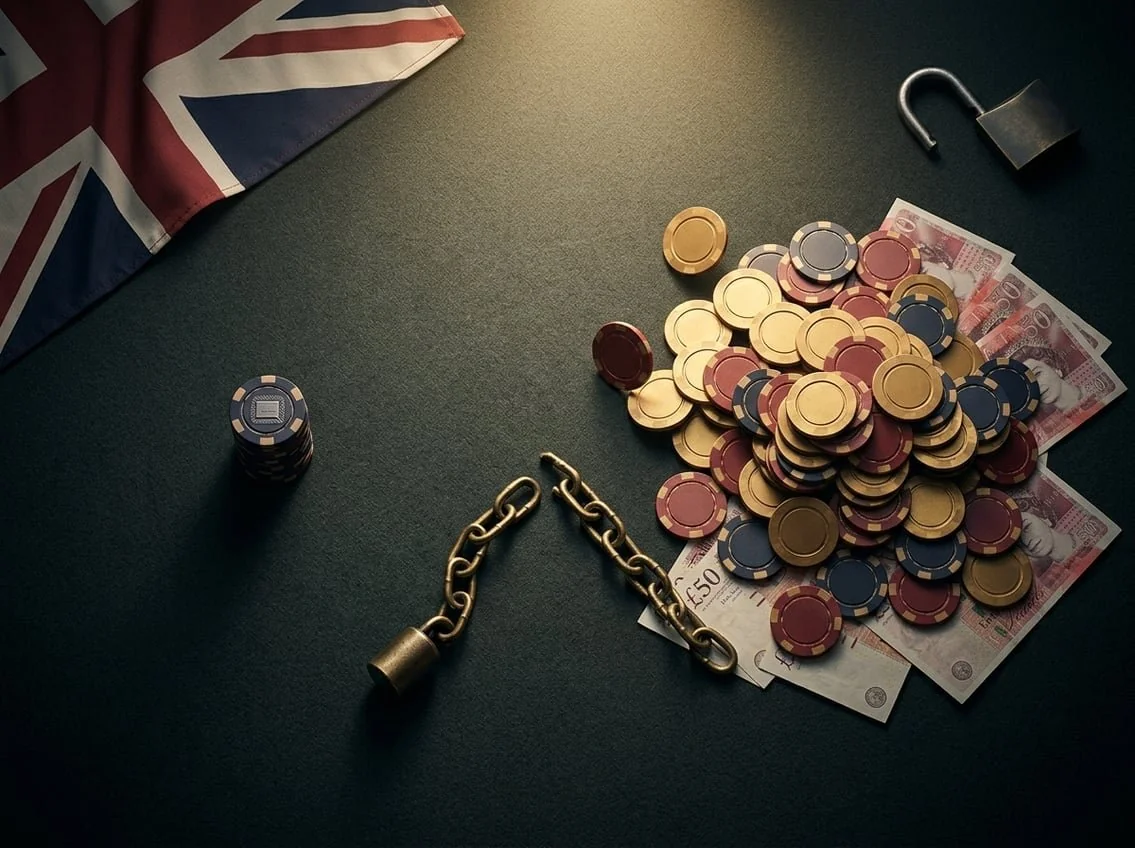

Every quarter for the past two years, a new set of numbers has landed on the UK offshore casino market. Yield Sec's 2025 report put UK offshore stakes at around £16.6 billion, with a projection above £33 billion by 2028. The Gambling Commission's affordability-check data, the Betting and Gaming Council's market updates, and independent monitoring firms have added their own reads on the same underlying phenomenon. The direction of all these numbers is the same. The magnitude has surprised almost everyone.
Alongside the numbers has come a wave of coverage from every direction of the industry. Newspaper editorials framing offshore growth as a public-health crisis. Trade press framing it as an unavoidable consequence of licensed-market restrictions. Affiliate sites framing it as the smart player's obvious choice. Anti-gambling campaigners framing it as evidence that the whole online market should be tightened further. Every one of those framings picks up a real strand of the story. None of them tells the whole thing.
This is our attempt to read the numbers without pushing them in any particular direction. We are a casino review publication with a commercial interest in the online market; readers should factor that in. What we cover here draws on our own monthly monitoring of the UK-facing operators on both sides of the licensed-versus-offshore line, the Spelinspektionen and Gambling Commission market data, the harm-reduction research literature, and the practical conversations we have with readers who are actually making the choice this article is about.
Where the £16.6 billion number comes from
Yield Sec, an intelligence firm that monitors offshore gambling activity through a mix of traffic analysis, payment-flow modelling, and direct market participant sampling, published the £16.6 billion figure as its 2025 estimate for UK-directed offshore casino stakes. The number is stakes, not gross gaming yield, which matters. Total UK licensed online gambling stakes were around £74 billion in the equivalent period. On those figures, offshore stakes are roughly eighteen to nineteen percent of total UK online gambling activity, depending on which baseline you use for the licensed side.
The projection to £33 billion by 2028 comes from Yield Sec's forward model, which extrapolates growth rates observed through 2023 to 2025 with adjustments for known policy catalysts (the April 2026 RGD increase and the pending 2027 GBD changes). It is a straight-line extrapolation with judgemental overlays, not a forecast in the econometric sense. It should be read as "if current trends continue" rather than as a firm prediction. In practice, the trend line is more likely to bend than to hold linear.
Other sources triangulate to broadly the same territory. The Betting and Gaming Council's market submissions ahead of the RGD budget put the offshore share at "material and growing" without a specific number. Independent AML-monitoring firms with visibility into payment flows have estimated numbers in a similar range. What no one has is a fully-audited direct measure. The offshore market is offshore in the specific sense that it is not reporting to a UK regulator, so every number attached to it is an estimate.
The direction of the estimates is unambiguous. The magnitude carries confidence-interval uncertainty of at least twenty percent in any direction, which is worth holding in mind whenever a specific figure gets cited as if it were bank-audited GAAP.
What is actually driving the growth
Four distinct factors are pulling in the same direction, which is why the trend has accelerated rather than plateaued. Each of them predated the 2026 changes; each of them was amplified by them.
Affordability checks. The Gambling Commission's affordability-check framework, tightened progressively through 2023 to 2025, is by some distance the largest single driver. When a UK-licensed operator asks a player for a bank statement or pay slip because their play pattern crossed a monitoring threshold, some proportion of those players do not complete the check. Of the players who do not complete, some stop playing entirely, and some move to operators that do not ask. The offshore market is where the second group lands.
Stake and product restrictions. The £2 online slots stake limit and other product-level restrictions removed high-volatility play options that a particular segment of experienced players actively preferred. Those players did not accept the restriction as a preference-signalling constraint; they moved to operators without it.
The RGD hike. Covered in detail in our April 2026 RGD analysis. The doubling of the remote gaming duty compressed licensed-operator margins and pushed welcome-bonus, wagering, and VIP terms downward. Offshore operators, not subject to RGD, could hold or improve their terms during the same period. For a player who cares primarily about promotional value received, the licensed-versus-offshore gap widened materially through April to September 2026.
Credit-card and BNPL restrictions. UK credit-card gambling was banned in 2020. Buy-now-pay-later restrictions have tightened through 2024 and 2025. For a player who previously funded gambling through credit-adjacent products, the licensed market simply does not offer a funding route any more. The offshore market does, for operators willing to accept the associated payment-processing risk.
The fifth candidate driver, GamStop self-exclusion, is different in character and deserves its own discussion.
The GamStop question, honestly
Active GamStop registrations crossed 562,000 by the end of 2025, with record monthly registration volumes in April and May 2026 following the RGD change. Active meaning currently within an exclusion period (six months, one year, or five years). The lifetime cumulative number of registrations is substantially higher because many people cycle through multiple exclusion periods.
GamStop is a genuine harm-reduction mechanism. It works by preventing UK-licensed operators from accepting registered players. For its intended use case (a person who recognises problem-gambling behaviour, opts into exclusion, and follows through), it is effective. Yield Sec's own data reports that a substantial proportion of offshore market traffic includes people who are actively excluded through GamStop, which is the concerning read.
Here is the honest structural point. A UK player who has registered with GamStop and then goes on to play at a non-GamStop offshore operator is defeating their own self-exclusion. Nothing about the offshore operator's licence quality, welcome bonus, or withdrawal speed changes that fact. This is not a nuanced trade-off. This is a strong signal that the player is in exactly the situation the self-exclusion was designed to protect against. Every reputable non-GamStop coverage in the world should acknowledge this and route the reader to real support if they see themselves in the description. GamCare operates the National Gambling Helpline in the UK; the number is 0808 8020 133 and it is available around the clock.
A different UK player, who has not registered with GamStop and simply prefers the terms or product mix available in the offshore market, is making a legitimate consumer choice within their own risk assessment. The trade-offs for that player are real and worth reading, but they are consumer-choice trade-offs, not harm-reduction ones.
Every serious piece of non-GamStop coverage has to make peace with this distinction. Coverage that treats the offshore market as universally appropriate is failing the first group of players. Coverage that treats it as universally inappropriate is being dishonest with the second group. We cover both groups on our non-GamStop UK page, and the framing is important enough that we open the page with it.
What the offshore market actually looks like now
"Offshore" is a single word that covers meaningfully different operator profiles. The category is not homogeneous, and reading its numbers as if it were is a source of most of the misleading commentary about it.
At the top end of the offshore market are operators licensed under mature offshore regimes. Malta's MGA licence is the most rigorous non-UK licence widely available to UK players. Isle of Man and Alderney licences carry substantive player protections. Post-LOK Curaçao licensing, covered in detail in our retrospective on the LOK reform, is meaningfully stronger than the old master-licence system that preceded it. Operators in this segment offer a genuine alternative product with real (though not UK-equivalent) player protections.
At the bottom end of the offshore market are operators licensed under permissive jurisdictions with limited enforcement. Anjouan, Costa Rica, and jurisdictions of similar profile issue licences that are effectively marketing labels rather than regulatory relationships. Operators in this segment vary enormously in quality; some are legitimate businesses that chose a light-touch jurisdiction for commercial reasons, and some are effectively unregulated. Reading the difference from the operator's website is difficult without direct testing.
Between the ends is a large middle segment of operators that are licensed under Curaçao or similar post-LOK frameworks, offering welcome bonuses and payment methods (including crypto and PayID-style rails) that the licensed UK market cannot offer, and holding themselves to a range of quality standards driven mostly by their own commercial reputation and their dispute-resolution track record. This is where the majority of the offshore volume sits and where most player experience actually happens.
Our own coverage on the non-GamStop UK page is limited to operators that meet our composite scoring threshold across licence quality, deposit and withdrawal testing, bonus terms, and support. Operators that fail our threshold do not appear on our shortlist, and the offshore market has more of those than we are comfortable with.
What the trade-offs actually are
For a UK player choosing between the licensed and offshore markets, the honest trade-off list looks like this.
Licensed market: what you get. Strong regulatory framework (UKGC is one of the most rigorous globally). Real dispute resolution through ADR bodies backed by the regulator. Affordability-check protection for players who benefit from external friction on spending. GamStop connection for players managing self-exclusion. Full AML and player-fund protections. Advertising and bonus restrictions that limit the most aggressive commercial behaviour. Access to major software providers on their full-RTP configurations.
Licensed market: what you give up. Welcome bonuses are smaller than the offshore market's, with tighter wagering. Product restrictions apply (£2 slots limit, autoplay restrictions, no bonus buys). Affordability-check friction that some players experience as intrusive. Fewer payment options (no crypto, no non-standard rails).
Offshore market: what you get. Larger welcome bonuses with more competitive wagering multipliers. Wider product selection including bonus-buy slots, unrestricted autoplay, and higher stake ceilings. Broader payment method mix, particularly crypto and pay-by-bank innovations. In most cases, faster cashier speeds. Less pre-transaction friction from affordability checking.
Offshore market: what you give up. No GamStop protection. Weaker regulatory framework, with quality varying dramatically between operators. Dispute resolution ranges from strong (MGA, post-LOK Curaçao) to effectively absent (low-tier offshore-only licences). Withdrawal disputes are harder to escalate. No affordability-check protection, which is a positive for some players and a real risk factor for others. Less predictable operator behaviour on account restrictions and terms changes.
Where a specific player lands on this trade-off is a personal risk-and-preference question. There is no correct universal answer. What is not honest is presenting either market as universally better than the other.
What the trend does and does not mean
The £16.6 billion figure is genuinely important. It tells us that the UK's licensed online gambling market is losing a substantial share of activity to the offshore alternative, and that policy design targeting the licensed market alone will produce less of the intended outcome than its designers might expect. That is a real policy consequence and a real market phenomenon.
The figure does not tell us that the licensed market is failing. UK-licensed operators are still processing the large majority of UK online gambling activity, on a framework that is meaningfully more player-protective than any offshore alternative. The offshore share has grown, but the licensed share is not going to zero, and licensed operators continue to be where the median UK player actually plays.
The figure does not tell us that offshore casinos are bad. It tells us that they are large. Whether any specific offshore operator is good, bad, or somewhere in between is a case-by-case question that depends on the specific operator's licence, corporate structure, dispute-resolution history, and cashier reliability. Our reviews are our best answer on that for the operators we cover.
The figure does not tell us that GamStop is broken. GamStop works for its intended use case. What the figure tells us is that some proportion of self-excluded players are working around their own self-exclusion, which is a harm-reduction concern the mechanism cannot fully address on its own. Fixing it requires either extending exclusion to offshore operators (which is a jurisdictional problem the UK does not have the sole tools to solve) or building more supportive infrastructure around exclusion so that the workaround is less appealing.
The figure does not tell us where the trend is going. The £33 billion projection is a straight-line extrapolation from a period of accelerating change. Straight-line extrapolations frequently mispredict what happens in the actual future. If the Autumn Statement 2026 delivered any transitional relief on RGD, if EU-level coordination on offshore market enforcement moves forward, or if a major offshore operator collapse hits player-fund confidence, the trend could bend meaningfully. It could also accelerate if the political pressure to further restrict the licensed market wins the current Whitehall argument.
What we will be watching through 2027
Several data releases and policy events will materially update the picture we have described.
- Yield Sec 2026 report, expected in Q2 2027. The first full-year read on the post-RGD offshore market and the update to the 2028 projection.
- Gambling Commission market data, quarterly. Deposit-volume and GGY trend at licensed operators, which triangulates against the offshore-share estimates.
- GamStop registration trajectory. Active registrations at 562,000 at end-2025; the mid-2027 update tells us whether the trajectory is holding or bending.
- Post-RGD operator consolidation. Which small and mid-tier UKGC operators fold or are acquired through 2027, and where the affected player accounts move.
- EU regulatory coordination. The EU-level appetite for coordinated offshore enforcement is growing but has not yet produced concrete action. Any movement here changes the offshore-market dynamics substantially.
- General Betting Duty 2027 change. The sports-betting duty change lands in April 2027. It is smaller than the RGD change but hits a different operator segment and may push the offshore-share numbers again.
Frequently asked questions
Is offshore gambling legal for me as a UK player?
Playing at an operator that is not UK-licensed is not itself an offence for the player. What is regulated in the UK is the provision of gambling services to UK residents, not the act of playing. Offshore operators serving UK players may or may not be committing an offence under UK law depending on the specifics of their marketing, licensing, and payment relationships; this is a matter between the operator and the Gambling Commission, not between the player and the regulator. Tax on gambling winnings is generally not payable in the UK for individuals; the operator pays duty, and the player does not pay income tax on wins. This continues to apply regardless of where the operator is licensed.
Should I move to an offshore casino?
The honest answer depends on why you are asking. If you are asking because you have registered with GamStop and want a workaround, the answer is no, and please consider contacting GamCare on 0808 8020 133 before you take any further step. If you are asking because you find the licensed-market welcome bonuses too small or the affordability checks too intrusive and you want to understand your options, the answer is that offshore is a legitimate consumer choice with real trade-offs on both sides. Our non-GamStop UK page covers what those trade-offs are and which operators we currently believe are worth considering.
Is a Malta-licensed casino as safe as a UKGC-licensed one?
Not equivalently, but closer than most affiliates admit. The Malta Gaming Authority is a serious regulator with real enforcement history. MGA player protections are meaningfully weaker than UKGC standards on affordability and player-fund segregation, and meaningfully stronger than most Curaçao licensees. For a player who does not need the specific UKGC protections around affordability checks and GamStop, an MGA-licensed operator is a reasonable second-best option.
What is the actual risk of an offshore casino not paying out?
Varies dramatically by operator quality. At a top-tier offshore operator (MGA-licensed, post-LOK Curaçao with clean track record, or IOM), non-payment risk is comparable to a UKGC operator, though the escalation path is longer. At a low-tier offshore operator, non-payment risk is genuinely elevated, and the practical dispute-resolution options are limited to whatever the operator's own licensing framework provides plus civil action, which is rarely economic. Our review methodology weighs the withdrawal test heavily precisely because this risk is the single largest player-experience differentiator in the offshore market. The full weighting is documented in our methodology.
Why is the offshore market growing so fast?
The short answer: because the licensed market has become progressively more restrictive since 2020, and each restriction has moved some proportion of players out of the licensed market rather than eliminating their play. The credit-card ban, the £2 slot stake limit, affordability checks, the RGD hike, and the pending GBD change are the largest specific catalysts. The long answer includes the offshore market's own competitive improvements (better welcome bonuses, better payment methods, better cashier speed) and the increasing consumer familiarity with crypto payments as an offshore-friendly rail.
What would slow the offshore trend?
Two categories of thing. First, licensed-market improvements that reduce the "why did I leave" motivation: better welcome offers (which would require RGD relief), removal of the £2 slot limit, or a rebalancing of the affordability-check framework toward less-intrusive risk detection. Second, offshore-market friction: EU-level coordinated enforcement, payment-processor onboarding restrictions on offshore operators, or a major offshore operator collapse that damages player-fund confidence. Neither category is on a firm policy schedule.
Where this article sits in our coverage
This is the fifth article in our 2026 news series on the regulatory and market changes reshaping the UK, AU, and EU online casino markets. The other four are the RGD-at-40-percent analysis, the Curaçao LOK one-year retrospective, the PayID pokies technical explainer, and the Swedish 2026 double-whammy. Read together, they describe an industry going through the largest regulatory reshuffle since the initial waves of national online-gambling legislation in the 2010s.
Sources and further reading
- Yield Sec, 2025 UK offshore gambling market report and quarterly updates.
- Gambling Commission market data releases, Q1 through Q4 2026.
- Betting and Gaming Council market submissions ahead of Autumn Statement 2026.
- GamStop transparency reports on active registration counts.
- GamCare National Gambling Helpline, 0808 8020 133, available 24/7.
- Our own monthly monitoring of UK-facing operators on both sides of the licensed-versus-offshore line, January 2026 through January 2027.
This article was published on 22 January 2027 and reflects the state of the UK offshore market as of that date. The next major data update is the Yield Sec 2026 full-year report in Q2 2027, and we will update this article when it lands. If you are struggling with gambling, contact GamCare on 0808 8020 133 for confidential support.